
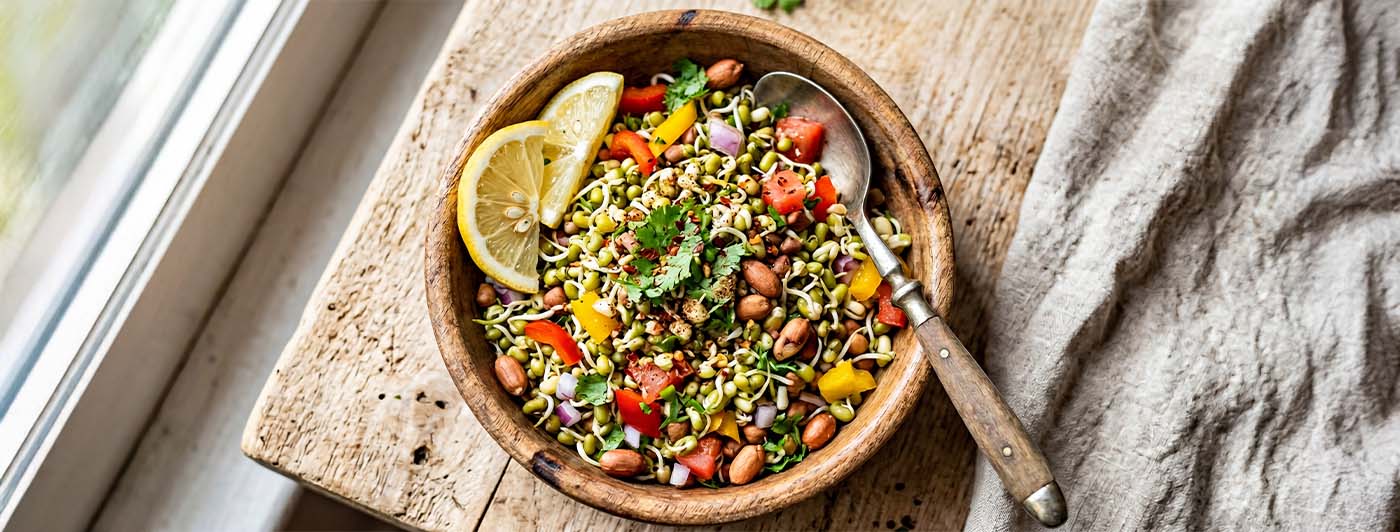
How much protein is in sprouts per 100g?
Protein in sprouts varies significantly by source: soybean sprouts lead at 13.1g/100g, followed by lentil sprouts (9g/100g), moong sprouts (3.4g/100g), chickpea sprouts (8.9g/100g), and wheat sprouts (7.5g/100g). Sprouting increases protein bioavailability in all cases by reducing phytic acid and activating digestive enzymes — meaning the protein in sprouts is more accessible to the body than equivalent protein in unsprouted form.
Introduction
Here's a fact that most people eating sprouts daily never fully appreciate: sprouting doesn't just maintain the protein in a seed or legume — it makes that protein significantly more useful to your body.
Most conversations about plant protein focus on dal, paneer, tofu, and supplements. Sprouts rarely make the list — despite being one of the most protein-dense, bioavailable, and preparation-free foods available in any Indian kitchen.
The science behind this is genuinely fascinating. When a seed germinates, it activates a cascade of enzymatic activity that breaks down phytic acid — the antinutrient that binds minerals and reduces protein absorption in unsprouted legumes. The result is a food where the same amino acids that were partially locked away become significantly more accessible.
For plant-based eaters, this distinction matters enormously. You could be consuming adequate protein on paper while absorbing significantly less in practice — simply by choosing unsprouted over sprouted sources. Understanding protein in sprouts — the exact numbers, the bioavailability advantage, and the daily framework — closes that gap entirely.
Key Points Summary
-
Protein in sprouts ranges from 3.4g per 100g in moong sprouts to 13.1g per 100g in soybean sprouts — making sprouted foods one of the most bioavailable and underutilised protein sources in any plant-based diet.
-
Sprouting reduces phytic acid by up to 50% — directly improving mineral and amino acid absorption
-
Moong sprouts are India's most widely consumed sprouted food — delivering 3.4g protein/100g with exceptional digestibility
-
Soybean sprouts lead all commonly available sprouts at 13.1g protein/100g — the highest protein in sprouts of any variety
-
Chickpea sprouts deliver 8.9g protein/100g — making sprouted chana one of the most protein-dense snack foods available
-
Sprouts require zero cooking — making them the lowest-effort high-protein food in any plant-based kitchen
Combining multiple sprout varieties across a day creates complementary amino acid coverage naturally
Exact Protein in Sprouts per 100g — Complete Data Table
|
Sprout Variety |
Protein per 100g |
Protein per Cup |
Key Amino Acid Strength |
|
Soybean Sprouts |
13.1g |
~14g |
Leucine, lysine, isoleucine |
|
Lentil Sprouts |
9.0g |
~7g |
Lysine, threonine |
|
Chickpea Sprouts |
8.9g |
~7g |
Arginine, lysine |
|
Kidney Bean Sprouts |
8.7g |
~7g |
Lysine, leucine |
|
Pea Sprouts |
5.6g |
~4g |
Leucine, lysine |
|
Fenugreek Sprouts |
4.4g |
~3g |
Isoleucine, lysine |
|
Moong Sprouts |
3.4g |
~3g |
Lysine, threonine |
|
Chia Sprouts |
3.3g |
~2g |
Complete amino profile |
|
Radish Sprouts |
3.8g |
~3g |
Sulforaphane + protein |
|
Wheat Sprouts |
7.5g |
~6g |
Methionine, cysteine |
|
Quinoa Sprouts |
4.4g |
~3g |
Complete amino profile |
|
Alfalfa Sprouts |
4.0g |
~3g |
Vitamin K, lysine |
|
Sunflower Sprouts |
3.8g |
~3g |
Methionine, vitamin E |
|
Buckwheat Sprouts |
3.4g |
~3g |
Complete amino profile |
|
Amaranth Sprouts |
3.8g |
~3g |
Lysine, methionine |
Why Sprouting Changes Everything About Plant Protein
Most people think of sprouting as a preparation method. It's actually a nutritional transformation.
When a seed or legume germinates, it undergoes a series of enzymatic reactions designed to fuel the emerging plant. These reactions — phytase activation, protease activity, amylase production — have profound effects on the nutritional profile of the food from a human consumption standpoint.
Phytic acid reduction is the most significant. Phytic acid is an antinutrient present in virtually all legumes and grains that binds to minerals and amino acids, reducing their absorption. Sprouting activates phytase [1]— an enzyme that degrades phytic acid — reducing its concentration by 20–50% depending on the legume and sprouting duration. The direct result: more protein and minerals absorbed per gram consumed.
Enzyme activation is the second key change. Sprouting activates proteases [2] — enzymes that partially pre-digest protein — making amino acids more readily available for absorption without requiring the full digestive workload of unsprouted legumes. This is why sprouted foods are consistently better tolerated by people with sensitive digestion.
Vitamin C synthesis is the third transformation. Sprouting generates vitamin C in foods that contain almost none in unsprouted form. This matters for protein nutrition because vitamin C enhances non-haem iron absorption — and iron is essential for oxygen delivery to the muscle tissue where protein synthesis occurs.
Understanding this makes the protein in sprouts data more than just numbers — it makes each gram of protein in a sprouted food genuinely worth more than the equivalent gram in an unsprouted source.
Protein in Sprouts — Detailed Breakdown by Variety
1. Soybean Sprouts — 13.1g Protein per 100g
Soybean sprouts deliver 13.1g of protein per 100g — the highest protein in sprouts of any commonly available variety — with all nine essential amino acids present in nutritionally significant quantities. Leucine content is particularly high (1.07g/100g) — directly triggering muscle protein synthesis at levels comparable to animal protein sources. Stir-fry with garlic and ginger, add raw to salads, or toss into soups — soybean sprouts are the most muscle-relevant sprouted food available and one of the most underused plant protein sources in Indian cooking.
2. Lentil Sprouts — 9g Protein per 100g
Lentil sprouts deliver 9g of protein per 100g — nearly double the protein of cooked lentils on a weight-for-weight basis — with a lysine profile that directly addresses the most common amino acid gap in grain-heavy Indian diets. Sprouting lentils for 24–48 hours at room temperature is one of the simplest nutritional upgrades available in any kitchen. Add raw to salads and chaat, or lightly steam and eat as a side — lentil sprouts are among the most lysine-dense protein in sprouts options available.
3. Chickpea Sprouts — 8.9g Protein per 100g
Chickpea sprouts deliver 8.9g of protein per 100g alongside arginine (0.93g/100g) — a combination that supports muscle protein synthesis and cardiovascular nitric oxide production simultaneously. Sprouted chana chaat is one of India's most nutritionally intelligent street food preparations — high protein, live enzymes, minimal preparation, zero cooking required. Eat raw with lemon and chilli, roast lightly, or add to salads — chickpea sprouts are among the most practically useful protein in sprouts options in the Indian kitchen.
4. Kidney Bean Sprouts — 8.7g Protein per 100g
Kidney bean sprouts deliver 8.7g of protein per 100g — and while raw kidney beans contain harmful lectins, sprouting for 3–4 days followed by light cooking eliminates this concern while preserving the protein advantage. Protein in rajma per 100g dry is approximately 24g — but sprouted kidney beans deliver nearly 9g per 100g in fresh weight, making them a strong protein source in a more digestible, lower-calorie format. Always lightly cook kidney bean sprouts before eating — a quick steam or stir-fry is sufficient and preserves most of the nutritional benefit.
5. Pea Sprouts — 5.6g Protein per 100g
Pea sprouts deliver 5.6g of protein per 100g alongside significant leucine content — the branched-chain amino acid most directly linked to muscle protein synthesis. Fresh and crisp with a naturally sweet flavour, pea sprouts are one of the most palatable raw protein in sprouts options available — requiring no seasoning or preparation to eat. Add to sandwiches, salads, or grain bowls — pea sprouts are the most flavour-neutral sprouted protein addition to any meal.
6. Fenugreek Sprouts — 4.4g Protein per 100g
Fenugreek sprouts deliver 4.4g of protein per 100g alongside galactomannan fiber that supports blood sugar regulation — making them particularly valuable for diabetic and pre-diabetic individuals seeking high-protein plant foods. The slight bitterness of fenugreek sprouts softens significantly after 48–72 hours of germination and integrates naturally into chaat, dal, and sabzi preparations. Consume in small quantities daily — fenugreek sprouts are among the most metabolically beneficial protein in sprouts options for blood sugar management alongside their protein contribution.
7. Moong Sprouts — 3.4g Protein per 100g
Moong sprouts deliver 3.4g of protein per 100g with the highest digestibility of any sprouted legume — low phytic acid and trypsin inhibitor concentrations make their amino acids exceptionally accessible to the body. A bowl of moong sprout chaat — lemon, chilli, onion, tomato — is one of the most nutritionally intelligent snacks in Indian food culture: high protein, live enzymes, zero cooking, maximum bioavailability. Eat raw daily as a snack or add to breakfast — moong sprouts are the most accessible and best-tolerated protein in sprouts option for daily use.
8. Wheat Sprouts — 7.5g Protein per 100g
Wheat sprouts deliver 7.5g of protein per 100g alongside methionine and cysteine — the sulphur-containing amino acids most commonly deficient in legume-heavy plant-based diets. Wheat sprouts strategically complement legume-based sprouts: legumes are high in lysine but low in methionine, while wheat sprouts directly address that gap. Add to salads, blend into smoothies, or eat raw — wheat sprouts are the most strategic methionine source among commonly available protein in sprouts varieties.
9. Quinoa Sprouts — 4.4g Protein per 100g
Quinoa sprouts deliver 4.4g of protein per 100g with a complete amino acid profile — all nine essential amino acids — making them one of the few sprouted grains that qualifies as a complete protein independently. Sprouting quinoa for 24–36 hours at room temperature is straightforward and dramatically improves its digestibility compared to cooked quinoa. Add raw to salads or use as a grain base — quinoa sprouts are the most amino acid-complete option among grain-based protein in sprouts varieties.
10. Alfalfa Sprouts — 4g Protein per 100g
Alfalfa sprouts deliver 4g of protein per 100g alongside exceptional vitamin K content (30mcg/100g) and a broad phytonutrient profile that includes saponins with documented cholesterol-lowering properties. Delicate and crisp, alfalfa sprouts require zero preparation and add protein and micronutrient density to any meal they're added to. Use as a topping on chilla, paratha, or salads — alfalfa sprouts are the most micronutrient-dense low-calorie option among protein in sprouts varieties available in India.
How Does Protein in Sprouts Compare to Other Plant Proteins?
Context makes the data meaningful. Here's how protein in sprouts compares to other commonly eaten Indian protein sources:
|
Food |
Protein per 100g |
Preparation Required |
|
Soybean sprouts |
13.1g |
None (raw) or 2 mins stir-fry |
|
Lentil sprouts |
9.0g |
None (raw) or light steam |
|
Chickpea sprouts |
8.9g |
None (raw) |
|
Moong dal (cooked) |
8g |
20–30 mins cooking |
|
Paneer |
18g |
Purchased ready |
|
Eggs |
13g |
5–10 mins cooking |
|
~6.5–8.5g per 50g serving |
5 mins cooking |
|
|
Tofu |
17g |
Minimal preparation |
The comparison reveals something striking: soybean and lentil sprouts deliver protein comparable to cooked dal — with zero cooking time and superior bioavailability. For anyone pressed for time, protein in sprouts is the most efficient whole-food protein strategy available.
Protein in Sprouts and Creatine — The Gap Worth Knowing
Unlike protein and amino acids, creatine cannot be increased through sprouting — sprouts contain negligible dietary creatine regardless of variety or germination stage, because creatine rich foods are almost exclusively animal-derived and no plant-based sprouting process can generate it.
For plant-based eaters targeting the strength and power benefits that creatine delivers, creatine monohydrate supplementation remains the only evidence-backed solution — but sprouts' leucine and lysine content supports muscle protein synthesis through entirely separate and complementary mechanisms that make them valuable alongside any supplementation strategy.
Building a Daily Protein Target Around Sprouts
Here's the honest calculation most people never do — what does a full day of deliberate sprout consumption actually deliver?
|
Meal |
Sprout Combination |
Protein from Sprouts |
|
Breakfast |
Moong sprout chaat (100g) + wheat sprouts (50g) |
~7.2g |
|
Mid-Morning |
Chickpea sprouts (100g) |
~8.9g |
|
Lunch |
Lentil sprouts added to dal (50g) |
~4.5g |
|
Snack |
Soybean sprouts stir-fry (100g) |
~13.1g |
|
Dinner |
Pea sprouts + quinoa sprouts salad (100g) |
~5g |
|
Daily Total |
~38.7g from sprouts alone |
Nearly 39g of protein from sprouts alone — before dal, roti, or any other protein source is counted. For anyone targeting a 150 gm protein diet, sprouts can contribute over 25% of that target from a food category most people treat as a garnish.
Use a protein intake calculator to establish your precise daily protein target, then map sprout varieties across your meals to understand exactly how much of your requirement they're covering.
Sprouts and Protein Supplements — Where Each Fits
A question increasingly relevant in India's growing fitness culture: can sprouts replace protein supplements?
Can I take protein powder without workout? Yes — protein supports daily bodily functions regardless of exercise: muscle maintenance, immune function, enzyme production, and hormonal regulation all require consistent protein intake whether you train or not.

Sprouts deliver protein in sprouts in a whole-food format with live enzymes, phytonutrients, vitamin C, and fiber that isolated supplements cannot replicate. Plant based protein powder from pea or soy sources concentrates protein for convenient post-workout recovery — useful when whole food intake falls short. But sprouts, consumed consistently across daily meals, deliver protein alongside a nutritional complexity no supplement can match.
The practical answer: sprouts and supplements serve different purposes. Sprouts build your nutritional foundation. Supplements fill specific gaps when whole food intake is insufficient.
How to Sprout at Home — A 3-Day Framework
Growing your own sprouts is the simplest, cheapest, and freshest protein upgrade available in any Indian kitchen.

Day 1 - Soaking Rinse 2–3 tablespoons of your chosen legume or grain thoroughly. Soak in 3x the volume of water for 8–12 hours at room temperature. Moong, lentils, and chickpeas all work reliably. Drain and rinse thoroughly after soaking.
Day 2 - Germination Transfer drained legumes to a clean muslin cloth or sprouting jar. Keep in a warm, ventilated spot away from direct sunlight. Rinse with fresh water twice daily — morning and evening — to prevent mould. Small tails (1–3mm) will appear within 24 hours for moong and lentils.
Day 3 - Harvest By 48–72 hours, sprouts are ready to eat. Longer germination increases enzyme activity and vitamin C content but slightly reduces starch concentration. Refrigerate in an airtight container — fresh sprouts keep for 3–5 days.
The entire process costs pennies per serving and delivers protein in sprouts that is fresher, more bioavailable, and more nutritionally active than any packaged alternative.
Connecting Protein in Sprouts to Your Complete Nutrition Strategy
Protein in sprouts is one layer of a complete plant-based protein strategy. The fuller picture includes dal, legumes, seeds, and whole grains working together to cover all nine essential amino acids across the day.
Sprouts contribute what few other foods can: live enzyme activity, zero cooking requirement, superior bioavailability, and a protein density that genuinely surprises most people when they see the numbers.
For serious plant-based athletes or anyone building a high-protein diet, sprouts belong at the centre of daily nutrition — not as a garnish or afterthought, but as a primary protein delivery mechanism that works in every meal format from breakfast chaat to dinner salad.
Conclusion
Sprouting is one of the oldest food preparation techniques on Earth — and one of the most nutritionally justified.
At 3.4g to 13.1g of protein in sprouts per 100g depending on variety, with bioavailability superior to unsprouted equivalents, zero cooking requirement, and a cost that rivals any protein source available, sprouts deserve a central role in any plant-based diet that most Indian kitchens are currently not giving them.
The numbers are clear. The preparation is simple. The nutritional return is exceptional.
Start with moong. Add chickpea. Build toward soybean. Let the cumulative effect of daily, diverse protein in sprouts intake do what no single food or supplement ever could.
FAQs
Q1: Which sprout has the highest protein content?
Soybean sprouts lead at 13.1g/100g — the highest protein in sprouts of any commonly available variety. Lentil sprouts (9g/100g) and chickpea sprouts (8.9g/100g) follow closely.
Q2: Are sprouts safe to eat raw?
Most sprouts — moong, lentil, chickpea, and alfalfa — are safe to eat raw when properly rinsed. Kidney bean sprouts are the exception and must be lightly cooked before consumption.
Q3: Can I eat 100g sprouts daily?
Yes — 100g of sprouts daily is safe and nutritionally beneficial. Rotate between moong, lentil, and chickpea sprouts for amino acid variety. Always lightly cook kidney bean sprouts before eating.
Q4: Which sprouts are high in protein?
Soybean (13.1g/100g), lentil (9g/100g), chickpea (8.9g/100g), and kidney bean sprouts (8.7g/100g) lead on protein in sprouts. Wheat sprouts (7.5g/100g) lead among grain-based varieties.
Q5: How much protein is in 100g of boiled sprouts?
Boiling reduces protein in sprouts by approximately 10–15%. Boiled moong sprouts deliver ~2.9g/100g, soybean sprouts ~11–12g/100g, and lentil sprouts ~7.5–8g/100g. Steaming preserves more protein than boiling and is the preferred cooking method.
References:
,%20moong%20sprouts%20(3.4g/100g),%20chic...)